|
|
|
|
|
|
|
|
|
British WW1 Aviation Art Print List
First World War Art  Aviation Art British Aviation Aviation Art British Aviation  British WW1 Aviation Print List British WW1 Aviation Print List |
[UP] - SE5 - Sopwith Camel - Bristol F2B - DH2 - DH4 - Sopwith Pup - Vickers Gunbus - Sopwith Triplane - Handley Page HP0400 - BE2C - Bristol Scout - RE8 - FE2 - Nieuport 10 - Nieuport 17 - Nieuport Scout - Felixstowe F.3 - Fairey IIID - Fairey IIIF - Morane Saulnier Type L - Sopwith 1.5 Strutter - Sopwith Tabloid - British WW1 Aviation Print List |
|
|
| Navigation | |
| Page 5 of 7 | Previous .. Page 5 .. Next |
|
|
|
|
|
|
|
|
|
|
|
|
|
|
|
|
|
|
|
|
|
| Navigation | |
| Page 5 of 7 | Previous .. Page 5 .. Next |
| Text for the above items : |
Tribute to Howard Saint by Ivan Berryman. Captain Howard J T Saint was a Welsh flying Ace who claimed 7 victories between August and October 1917 and was awarded the Distinguished Service Cross. He is shown here in his personal aircraft, Sopwith Triplane N6295 'B' in August 1917 - the aircraft in which he claimed a reconnaissance aircraft on the 21st and an Albatros D.V on the 25th, his 3rd and 4th victories. He claimed a further 3 victories while flying Sopwith Camels before becoming a test pilot, continuing a career in aviation until his retirement. He died in 1976 at the age of 83. |
Christmas Hunt - Bristol Fighter F2B by David Pentland. 139 Squadron RAF in North Italy, December 1917 |
Last Dogfight of Werner Voss by Ivan Berryman. The air battle that took place above the trenches of France on the evening of 23rd September 1917 was to go down in history as one of the most extraordinary dogfights ever. The young German ace Werner Voss found himself engaged with no fewer than eleven SE5s of 56 Sqn, among them British aces such as James McCudden and Arthur Rhys Davids. Hugely outnumbered, the brave Voss saw off several British aircraft with his amazing airmanship and accuracy of fire. Again and again he could have fled the scene due to his Triplanes superior rate of climb, but his attacks were insistent and deadly. His final moments came when Rhys Davids found himself on the tail of Voss and fired both his Lewis and Vickers guns into the little turqoise Triplane which was seen to drift toward the ground, his aircraft inverting before impact, killing Voss instantly. The painting shows Voss distinctive pre-production Fokker F. 1, with the yellow nose of Jasta 10, being pursued by the SE5 of Rhys Davids while, high above,a Spad is helping to keep a gaggle of Albatross DVs at bay. |
Captain Robert Little by Ivan Berryman. With a final 47 victories to his credit, Robert Alexander Little was one of the highest-scoring British aces of World War 1, beginning his career with the famous No 8 (Naval) Squadron in 1916, flying Sopwith Pup N5182, as shown here. On 21st April 1917, he was attacked and shot down by six aircraft of Jasta Boelke, Little being thrown from the cockpit of his Sopwith Camel on impact with the ground. As the German aircraft swooped in to rake the wreckage with machine gun fire, Little pulled his Webley from its holster and began returning fire before being assisted by British infantry with their Lewis guns. Such was the character of this great pilot who finally met his death whilst attacking Gotha bombers on the night of 27th May 1918. |
Albert Ball by Ivan Berryman. Albert Ball in his Nieuport 17 having just shot down a German LVG. His aircraft, A134, was distinctive in having a bright red spinner. He was the first Royal Flying Corps pilot to score a hat-trick (3 kills on a single mission) and, in the course of his career, scored another two on his way to his outstanding 44 victories. |
One in the Bag by Ivan Berryman A German Albatross D-III sees off a Bristol Fighter among the clouds over the Western Front, early in 1917. The D-III was a massive improvement over the monoplanes of the time, possessing greater manoeuvrability, a higher ceiling and synchronized guns. Many German aces thought this the best fighter of the First World War. |
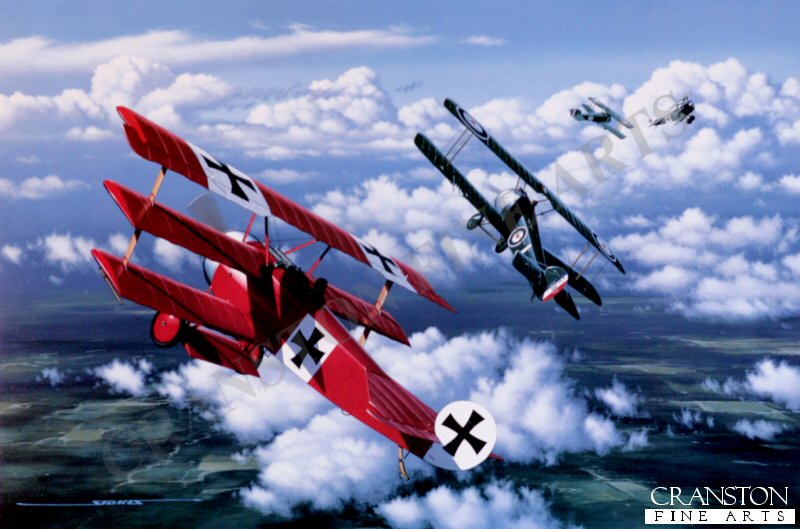
The Ringmaster by Stan Stokes. Born in Prussia to wealthy aristocratic parents, Manfred Freherr von Richtofen, The Red Baron, was to become the top ace of World War I, with 80 confirmed kills, and probably another 40-50 which took place over enemy lines and could not be confirmed. Richtofen was originally a cavalry officer, but with great persistence he was transferred to the air arm. After a brief period on the eastern front Richtofen was transferred to the western front in August 1915. His first confirmed victory was recorded in September 1916 and by November he recorded eleven kills, including Major Lance Hawker, the top British fighter pilot. With his keen reflexes and eyesight he quickly ascended, and by June 1917 Richtofen took control of a unit near Coutrai. This unit became known as Richtofens Circus. By July the ringmaster had his fifty-seventh victim. Despite his successes Richtofen shunned publicity and became increasingly withdrawn. Richtofen was wounded in combat and spent three weeks in the hospital recuperating. After his return to duty Manfred became a vocal proponent of the Fokker triplane. The bright red paint scheme utilized on one of Richtofens aircraft is what earned him the nick-name, The Red Baron. Richtofens brother, Lothar, was also an ace with forty victories to his credit. By April of 1918, aided by Americas entry into the War, Germany was facing overwhelming numbers of enemy aircraft, and many with performance capabilities the equal to, and in some cases superior to, their own. The Germans mounted a final desperate offensive, and on April 21,1918 The Red Baron finally fell victim to the perils of combat. Although there is considerable controversy over the Red Barons demise, it appears that Richtofen was either killed by Captain Arthur Brown, a Canadian flying with the RAF, or was shot down by Australian machine gunners while evading Captain Brown. Richtofen was provided a full military funeral by the Allies, and on the evening following his funeral a single RAF fighter dropped a small package containing photos of the funeral onto the Circus headquarters. By Wars end the Circus was credited with the destruction of 644 aircraft, but 56 of its airmen had been killed, 32 seriously wounded, and 6 captured. Richtofen is pictured in July of 1917 tangling with Sopwith Camels in the skies over Belgium. Flying his beloved Fokker triplane, the infamous Red Baron is shown positioning his aircraft for yet another victory. |
Tribute to Ferdinand West VC by Ivan Berryman. Known as Freddie, West was the first pilot of the newly formed Royal Air Force to be awarded the Victoria Cross. He is shown here during a bombing mission to Merricourt on 19th June 1918. Jumped by enemy fighters, he was forced to evade his assailants by weaving through German barrage balloons. Successfully shaking off the Fokkers in Armstrong-Whitworth FK.8 C8594, he continued to his intended target. Less than two months later, and in a similar aircraft, he undertook the mission which earned him his VC, but cost him an amputated leg. He remained in the RAF until the end of World War Two and lived until 1988, aged 92. |
Manfred Von Richthoffen (The Red Baron) by Tim Fisher. The scene depicts an encounter between Manfred Von Richthoffen, leader of the Jasta II squadron and a patrol of Sopwith Camels. This particular battle above France took place only weeks before Richthoffen was killed as can be seen from the Balken Kreuz insignia which replaced the iron cross on German aircraft after a directive dated March 1918. |
Early Morning Preparations by Robin Smith. RE8s of 69 Squadron being prepared for another sortie. One can only be left to imagine the contrast between the peaceful early morning scenario, and the carnage the pilot and observer could be experiencing in a couple of hours time over a foreign land. |
Major William Barker VC, DSO - Nearly an Ace in a Day by Ivan Berryman. Flying Sopwith Snipe E8102 on 27th October 1918, Major William Barker encountered a flight of fifteen Fokker D.VIIs and decided to take them on single handed. Having downed one enemy aircraft, Barker was wounded in his left thigh and momentarily fainted. Coming to, he found another D.VII ahead of him and immediately resumed the battle. Another bullet now tore into his right leg and another shattered his left elbow. Despite his terrible injuries, Barker shot down three D.VIIs and drove the others off before crash landing his bullet-riddled Snipe in friendly territory. He survived the crash and was awarded the VC for his gallantry on this epic flight. |
Tribute to Freddie West VC by Ivan Berryman. On the 11th of August 1918, the Armstrong Whitworth FK8 C8602 of Ferdinand 'Freddie' West and his observer / gunner John Haslam was one of hundreds of aircraft tasked with locating German reserves on the ground to assist the Army. A gap in the clouds revealed a concentration of German troops - they dived low to assess their number but coming under intense fire returned to the clouds. Not satisfied that the enemy positions had been identified correctly, West dived again. Attacked by several aircraft and wounded, West pressed on with his low flight to gather further intelligence. Finding 'troops, guns and vehicles in all directions', they knew they had found the German reserves. Turning for home they encountered more German scouts. This time, the attack left their aircraft badly damaged and West was hit in the leg by five bullets, one of which severed an artery. With Haslam taking aim at the fighters while West tried to take evasive action, they managed to escape. Half fainting through blood loss, West fashioned a tourniquet from a leg of his shorts, and drifting into semi-consciousness, landed the aircraft behind Allied lines. He insisted that he should personally pass on the intelligence to his No.8 Sqn superiors, and lost consciousness after doing so. Sir John Salmond, in charge of the Air Force in France, put him forward for the Victoria Cross which was awarded for 'unparalleled pluck and endurance. The valour displayed by this officer has throughout been a magnificent example to his flight, which he has inspired with his devotion, courage and power of endurance.' Despite losing his leg, with an artificial limb he returned to flying duties after the war and remained in the Royal Air Force until the end of World War Two. He died in 1988. |
The Eyes of the Fleet - A Short Seaplane by Geoffrey Watson. No text for this item |
Lieutenant Rhodes-Moorhouse Flying Over Courtrai to Bomb the Railway by Allan Stewart. On April 26th 1915, 2nd Lieutenant William Barnard Rhodes-Moorhouse, of the Special Reserve, Royal Flying Corps, set out from the British lines for the purpose of raiding the railway at Courtrai. On reaching the place he planed down to a height of 300 ft, and, under heavy shell fire, bombed the railway near the station. As he started on his return journey he received a mortal wound, but with great pluck and determination kept control of his aeroplane. He flew back, at a very low altitude, a distance of 35 miles to his starting point, and reported the success of his undertaking. He subsequently died of his wounds, but for his most conspicuous bravery a posthumous award of the VC was made. |
Seeing Red by Ivan Berryman. Credited with no fewer than 80 victories, Manfred Von Richthofen, The Red Baron, became legendary, not least for the 17 kills scored whilst flying the diminutive Fokker DR1 Triplane. Contrary to popular belief, however, only one of his aircraft is known to have been painted all red. Serial no. 477/17 is shown here dicing with an SE5. |
The Big Push - Passchendaele 1917 by Anthony Saunders. Swamped by mud amidst a desolate, shattered landscape, men and horses of the Royal Field Artillery drag their 18 pounder field-gun towards a new position on 15 November 1917, during the final days of the Battle of Passchendaele. Whilst the army continues its grim fight on the ground, overhead Sopwith Camels from 45 Squadron Royal Flying Corps tangle in an equally deadly duel with German Albatros fighters of Jasta 6. Flying the lead Sopwith Camel is the RFC Ace, 2nd Lt Kenneth Montgomery who scored the last of his 12 victories in this dogfight when he shot down the German Ace Leutnant Hans Ritter von Adam, the Commanding Officer of Jasta 6 with an impressive 21 victories to his name. To commemorate one of the most significant anniversaries in history, Anthony Saunders has created a powerful painting portraying the bleak sacrifice made by so many heroic young men. The names of the bitter battles they endured, however, still live on a hundred years later - Ypres, the Somme, Vimy Ridge, Arras, Loos - and one of the most savage - Passchendaele. |
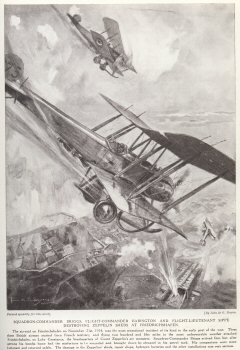
Squadron- Commander Briggs, Flight Commander Babington And Flight Lieutenant Sippe Destroying Zeppelin Sheds At Friedrichshafen. The air raid on Friedeichshafen on November 21st 1914 was the most sensational incident of its kind in the early part of the war. These three British airmen started from French territory, and flying two hundred and fifty miles in the most unfavourable weather attacked Friedrichshafen, on Lake Constance, the headquarters of Count Zeppelins monsters. Squadron-Commander Briggs arrived first, but after getting his bombs home had the misfortune to be wounded and brought down by shrapnel in his petrol tank. His companions were more fortunate and returned safely. The damage to the Zeppelins sheds, repair shops, hydrogen factories and the other installations was very serious. |
Flight Sub-Lieutenant R. A. J. Warneford, R.N. Won The V.V. For Blowing Up A Zeppelin Between Ghent And Brussels. At 3 oclock on the morning of the 7th June 1915, flight Sub-Lieutenant R. A. J. Warneford, R.N., attacked a Zeppelin in the air, between Ghent and Brussels, at 6,000 feet. He dropped six bombs, and the airship exploded, fell to the ground, and burst for a considerable time. The force of the explosion caused the Morane monoplane to turn upside down. The pilot succeeded in returned fighting the machine, but had to make a forced landing in the enemys country. However, he was able to re-start his engine and returned safely to the aerodrome. Within twenty-four hours he was awarded the V.C., notification being conveyed to him in a telegram from His Majesty the King. Also, the French Authorities conferred upon him the Cross-of a Chevalier of the Legion of Honour, in recognition of his brilliant exploit. |
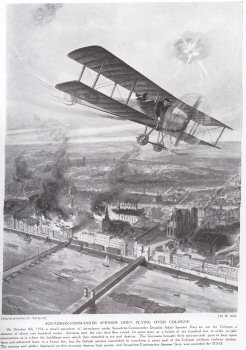
Squadron-Commander Spenser Grey Flying Over Cologne. On October 8 th 1914, a small squadron of aeroplane under Squadron Commander Douglas Adair Spenser Grey set out for Cologne, a distance of about two hundred miles. Arriving over the city, they flew round for sometime at a height of six hundred feet, in order to take observations as to where which they intended to try and destroy. The Germans brought their anti aircraft guns to bear upon them and subjected them to a heavy fire, but the British airmen succeeded in wrecking a great part of the Cologne military railway station. The courage and ability displayed on this occasion deserve high praise, and Squadron Commander Grey was awarded the D.S.O. |
Lieutenant George F. Pretyman, Of The Royal Flying Corps, Blowing Up A Train. Believing that the enemy was concentrating men for a big attack at some point on the Allied lines, Lieutenant Pretyman ascended in his aeroplane to make a reconnaissance. On looking down on the station at Don he saw a battalion forming up outside the railway buildings. Circling back over the station with shrapnel bursting all round him, he dropped a bomb on a train, completely wrecking the centre of it, as it stood ready alongside the platform. Though a German aeroplane swept down to attack him, he drove it off. Lieutenant Pretymans great gallantry, ability and initiative were afterwards rewarded with the D.S.O. |
Air Mechanic Prance Assisting To Repair An Aeroplane Under Heavy Shellfire. During the battle of Neuve Chapelle, March 10th-12th 1915, great activity was shown by the British airmen, whose plans were brilliantly conceived and executed. The weather, however, was extremely bad for flying, and it compelled the airmen to fly no higher than one hundred to one hundred and fifty feet, and thus run great risks. On the night of March 10th, one of the British aeroplanes was forced to descend near the firing line, and 2nd class Air Mechanic J. E. Prance, of the Royal Flying Corps, set to work to help in repairing it. Shells burst all round Prance and his comrade, but the two men worked with such enthusiasm that the machine was ready for flying the next morning. For his valuable services Prance was rewarded with the D.C.M. |
|
Contact Details |
|
Sign Up To Our Newsletter!
This website is owned by Cranston Fine Arts. Torwood House, Torwoodhill Road, Rhu, Helensburgh, Scotland, G848LE Contact: Tel: (+44) (0) 1436 820269. Email: cranstonorders -at- outlook.com
|
 |