|
|
|
|
|
|
|
|
|
British WW1 Aviation Art Print List
First World War Art  Aviation Art British Aviation Aviation Art British Aviation  British WW1 Aviation Print List British WW1 Aviation Print List |
[UP] - SE5 - Sopwith Camel - Bristol F2B - DH2 - DH4 - Sopwith Pup - Vickers Gunbus - Sopwith Triplane - Handley Page HP0400 - BE2C - Bristol Scout - RE8 - FE2 - Nieuport 10 - Nieuport 17 - Nieuport Scout - Felixstowe F.3 - Fairey IIID - Fairey IIIF - Morane Saulnier Type L - Sopwith 1.5 Strutter - Sopwith Tabloid - British WW1 Aviation Print List |
|
|
| Navigation | |
| Page 6 of 7 | Previous .. Page 6 .. Next |
|
|
|
|
|
|
|
|
|
|
|
|
|
|
|
|
|
|
|
|
|
| Navigation | |
| Page 6 of 7 | Previous .. Page 6 .. Next |
| Text for the above items : |
Lieutenant Swain Lewis Flying over the German Lines to Direct Artillery Fire. No text for this item |
An Aerial Duel Between a British Biplane and a Large German Biplane. While piloting a biplane near Poelcapelle on June 20th 1915, Flight-Lieutenant W. H. D Acland of the Royal First Devon Yeomanry and the Royal Flying Corps was attacked by a large German biplane. At less than two hundred yards distance the British observer replied to the fire of the hostile aeroplane. He, after whom the German biplane was seen to rock; fired fifty rounds and on firing again it dived down, and then flattened its course to continue slowly and erratically to the ground. A bursting shell set alight the British biplane when returning, and the two officers were severely burned. With great courage and presence of mind, however, Lieutenant Acland brought the aeroplane safely to the ground. He was subsequently rewarded with the Military Cross, and the Order of St. George (Fourth Class) was bestowed on him by the Czar of Russia. |
An Aerial Action In Which Corporal Nott. Acting As Gunner, Drove Off A Hostile Aeroplane After Being Seriously Wounded. While acting as gunner on escort duty, Corporal C. H. Nott, of No. 15 Squadron, Royal Flying Corps, was hit in the eye and rendered unconscious during an aerial action. On recovering his senses he at once opened fire with his gun, and succeeded in driving off the enemys aeroplane, which had pressed the attack. His machine was riddled with shot and otherwise damaged, but without his magnificent pluck all would have been lost. For his conspicuous gallantry Corporal Nott was awarded the D.C.M. |
Captain Liddell Piloting His Aeroplane Down into The British Lines After Being Seriously Wounded. While on a flying reconnaissance over Ostend, Bruges and Ghent, on July 31st 1915, Captain John Aidan Liddell of the 3rd Battalion Princess Louises Argyll and Sutherland Highlanders, was severely wounded, his thigh being broken. For a moment he lost consciousness and dropped nearly three thousand feet, but by a great effort he recovered partial control, and, though in a state of collapse, succeeded in completing his course while being continually fired at. He brought the aeroplane into the British lined half an hour after being wounded. Apart from his personal injuries, the difficulties experienced by Captain Liddell in saving the machine and the observer were very great, as the control wheel and throttle control of the machine, and also one of the under carriage struts, were smashed. For his most conspicuous bravery and devotion to duty, Captain Liddell was awarded the V.C., but unfortunately died of his injuries. |
The destruction of a German seaplane by Flight Sub-Lieutenant Ince off the Belgian Coast. On December 14th 1915, a British aeroplane, piloted by flight Sub Lieutenant Graham, engaged a German seaplane, which was flying off the Belgian coast. The British observer and gunner, Flight Sub Lieutenant Arthur Strachan Ince, R.N. proved victorious, the enemys seaplane being destroyed. For his valuable services, flight Sub Lieutenant Ince was awarded the D.S.O. |
Squadron Commander Davies ascending in his aeroplane after taking flight Sub Lieutenant Smylie onboard. The enemy were soon hard on the track of Lieutenant Smylie. But, having descended at a safe distance from the burning aeroplane, Commander Davies took up Lieutenant Smylie and returned to the aeroplane. For skill and gallantry this feat of airmanship can seldom have been equalled, and Commander Davies was deservedly rewarded with the V.C. This item depicts the event in November 1915 for which Richard Bell Davies (subsequently Vice Admiral) was awarded the Victoria Cross on 1st January 1916. During a bombing mission over Bulgaria, the aircraft of Sub Lt Gilbert Smylie was damaged by ground fire and forced to land. He jettisoned his bombs while still in the air, but one failed to release and remained with the aircraft as it crash-landed. Smylie set fire to his machine and set to depart, intending for the remaining bomb to explode in the flames, but saw Squadron Commander Bell Davies descending towards the burning wreckage. He returned to the ordnance and detonated it by means of a pistol shot from close range ensuring the safe descent and landing of Bell Davies' aircraft. With the enemy approaching, Bell Davies took Smylie into his machine in the most cramped conditions, but returned to the aerodrome safely. For this, Bell Davies was awarded the Victoria Cross and Smylie the Distinguished Service Cross. It is thought to have been the first combat rescue by aircraft of this kind in history. |
Squadron Commander Davies and Flight Lieutenant Peirse dropping bombs on the submarine station at Zeebrugge under heavy fire. Squadron Commander Richard Bell Davies, R.N., and Flight Lieutenant Richard Edmund Charles Peirse have repeatedly attacked the German submarine stations at Ostend and Zeebrugge, while being subjected to heavy and accurate fire, during which their machines have frequently been hit. On January 23rd 1915, they flew over Zeebrugge, and at the beginning of the fight Squadron Commander Davies was severely wounded by a bullet in the thigh. But having planed down to close range, the two officers discharged eight bombs upon the German submarines, which were lying alongside the mole. In spite of pain and loss of blood Squadron Commander Davies handled his machine for an hour with great skill. Both officers were awarded the D.S.O. |
Lieutenant Hawker dropping bombs on a German airship shed at Gontrode. On April 19th 1915, Lieutenant Lance George Hawker, of the Royal engineers and Royal flying Corps, succeeded in dropping bombs on a German airship shed, at Gontrode, from a height of only two hundred feet. He displayed remarkable ingenuity in making use of an occupied German captive balloon to shield him from fire whilst manoeuvring to drop the bombs. For his conspicuous gallantry he was awarded the D.S.O. and was subsequently promoted to be Captain. |
Captain Hawkers aerial battle with three German aeroplanes. On July 25th 1915, Captain Hawker fought an extraordinary valiant action three German aeroplanes, which were each manned by a pilot and observer, and armed with a machine gun. The first managed to escape; the second was put out of action, and compelled to descend: while the third, which was assailed at a height of ten thousand feet was not only badly damaged, but was driven to ground in the British lines, both the pilot and observer being killed. For his exceptional bravery on this occasion Captain Hawker was awarded the V.C. |
Second Lieutenant Henderson Flying down into the British lines after his left leg had been severed by a shell. While making a photographic reconnaissance over the enemys lines, the aeroplane in which Second Lieutenant (temporary Lieutenant) Malcolm Henderson, of the 4th (Ross Highland) Battalion, Seaforth Highlanders (Rosshire Buffs, the Duke of Albanys) Territorial Force, and Royal Flying Corps, was flying, was struck by a shell from a German anti aircraft gun. Passing through the nacelle of the machine, the shell took off Lieutenant Hendersons left leg just below the knee. In spite of this serious injury he succeeded in planing down from a height of 7,000 feet and in safely landing 3,000 yards behind the British lines. His cool and courageous action, for which he was awarded the D.S.O. saved the life of the observer. |
Second Lieutenant Strange bombing the railway junction at Courtral. For his gallantry and ability on reconnaissance and other duties on numerous occasions, but especially on the occasion when he dropped three bombs from a height of only two hundred feet on the railway junction at Courtrai, whilst being assailed by heavy rifle fire, Second Lieutenant (temporary Captain) L. A. Strange, of the Dorsetshire Regiment and Royal Flying Corps, was awarded the M.C. |
Corporal J. H. Waller Dives On To An Enemy Biplane And Shoots It Down. On one occasion, as passenger on an aeroplane, Corporal J. H. Waller, of No. 25 Squadron, Royal Flying corps, dived on to an enemy biplane and shot it down. On another occasion, as passenger, he shot down a Fokker, which was also seen to crash to the ground. For his conspicuous gallantry and skill he was awarded the D.C.M. |
The First Fight Between Warships And Zeppelins. On the Christmas Eve of 1914 three vessels, carrying seaplanes, left Harwich, escorted by cruisers, destroyers and submarines, for an aerial reconnaissance at Heligoland and the German North Sea ports. Seven aeroplanes were taken, and they were launched in spite of a dense fog. When the fog began to clear, the British ships found themselves pursued by two Zeppelins and several German seaplanes, as they were proceeding to the spot where they were to meet the returning airmen. The light cruisers Arethusa and Undaunted opened fire, and some 6-inch shells burst very close to the Zeppelins, which turned and made off. The seaplanes were more daring, but, though they got directly over the ships, they did not succeed in hitting them. |
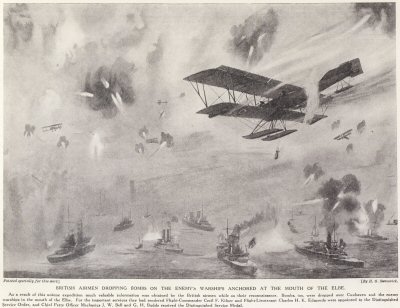
British Airmen Dropping Bombs On The Enemys Warships Anchored At The Mouth Of The Elbe. As a result of this unique expedition the British airmen while in their reconnaissance obtained much valuable information. Bombs too were dropped over Cuxhaven and the enemy warships in the mouth of the Elbe. For the important services they had rendered flight-Commander Cecil F. Kilner and Flight-Lieutenant Carles H. K. Edmonds were appointed to the Distinguished Service Order, and Chief Petty Officer Mechanics J. W. Bell and G. H. Budds received the Distinguished Service Medal. |
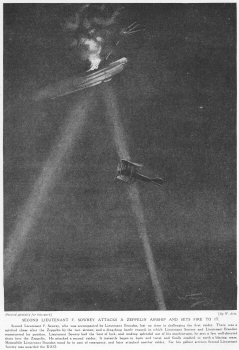
Second Lieutenant F. Sowrey Attacks A Zeppelin Airship And Sets Fire To It. Second Lieutenant F. Sowrey who was accompanied by Lieutenant Brandon, lost no time in challenging the first raider. There was a spirited chase after the Zeppelin by the two airmen, and a ding-dong battle ensued, in which Lieutenant Sowrey and Lieutenant Brandon manoeuvred for position. Lieutenant Sowrey had the best of luck, and making splendid use of his machine gun, he sent a few well-directed shots into the Zeppelin. He attacked a second raider. It instantly began to burn and twist, and finally crashed to earth a blazing mass. Meanwhile Lieutenant Brandon stood by in case of emergency, and later attacked another raider. For his gallant services Second Lieutenant Sowrey was awarded the D.S.O. |
Lieutenant W. R. Freeman Locating the Enemys Batteries And Giving Information By Wireless Messages To The British Artillery. Flying over the German lines, Lieutenant W. R. Freeman, of the Manchester Regiment and Royal Flying Corps, located the position of batteries, and conveyed the information by wireless messages from his aeroplane to the British artillery. Although the enemys bullets pierced his propeller and planes, he remained aloft for more than five hours during the day. For his gallantry, ability, and the very valuable work he performed, Lieutenant Freeman was deservedly awarded the M.C. |
Second Lieutenant (Temporary Captain) H. V. C. De Crespigny Attacking Five enemy Aeroplanes Over The Enemys Lines. On one occasion Second Lieutenant (Temporary Captain) Hugh Vivian Champion de Crespigny, of the Suffolk Regiment and Royal Flying Corps, attacked five enemy aeroplanes over the enemys lines. He drove away one, and brought another to the ground badly hit. The fire of the remaining three then crippled his own machine, but after emptying one more drum at them, he brought his machine down. For his conspicuous gallantry and skill he was awarded the D.S.O. |
Temporary Second Lieutenant L. F. Forbes Descending To Within 350 Feet To Bomb The Railway. Temporary Second Lieutenant Leslie Frederick Forbes, General List and Royal Flying Corps, has displayed conspicuous gallantry and ability in attacking hostile machines and in bombing railway lines, especially on one occasion when he descended to 350 feet order to accomplish his object. He was subsequently awarded the M.C. |
Flight Commander A. W. Bigsworth Drops A Bomb On A Zeppelin Airship, Severely Damaging It. On May 17th 1915, a Zeppelin airship raided the East Coast, and on her return journey was intercepted by eight British naval aeroplanes from Dunkirk, Flight-Commander Arthur Wellesley Bigsworth, who was piloting one of the machines, rose 200 feet above the airship and dropped a bomb which burst in her compartments, sending her home severely damaged. For his skilful and daring achievement he was promoted from Flight-Commander to Squadron-Commander. |
Captain W. D. S. Sanday Brings Down An Enemy Machine In Flames. Captain William Douglas Stock Sanday has led over thirty-five patrols with great gallantry. On one occasion a machine of his formation was attacked, but he charged and brought down the enemy machine in flames. He had destroyed at least four enemy machines, and has been awarded the D.S.O. for his conspicuous gallantry and skill. |
Second Lieutenant W. H. C. Buntine Attacking Hostile Aeroplanes, One Of Which Falls To The Ground Nose First. As escort to a bombing raid, Second Lieutenant Walter Horace Buntime, of the Notts and Derby Regiment and Royal flying Corps, attacked several hostile machines, one of which fell to the ground nose first. Later three enemy machines attacked him, his own machine being damaged and severely wounded. With great skill he managed to land in the British lines, though most of his propeller was shot away and his machine otherwise much damaged. He was awarded the M.C. for his conspicuous gallantry and skill. |
|
Contact Details |
|
Sign Up To Our Newsletter!
This website is owned by Cranston Fine Arts. Torwood House, Torwoodhill Road, Rhu, Helensburgh, Scotland, G848LE Contact: Tel: (+44) (0) 1436 820269. Email: cranstonorders -at- outlook.com
|
 |