|
|
|
|
|
|
|
|
|
First World War Art  Postcards Postcards |
| Navigation | |
| Page 1 of 12 | Page 1 .. Next |
|
|
|
|
|
|
|
|
|
|
|
|
|
|
|
|
|
|
|
|
|
| Navigation | |
| Page 1 of 12 | Page 1 .. Next |
| Text for the above items : |
Death and Glory in Flanders Fields by Chris Collingwood. (PC) The 17th Lancers in Flanders 1916. |
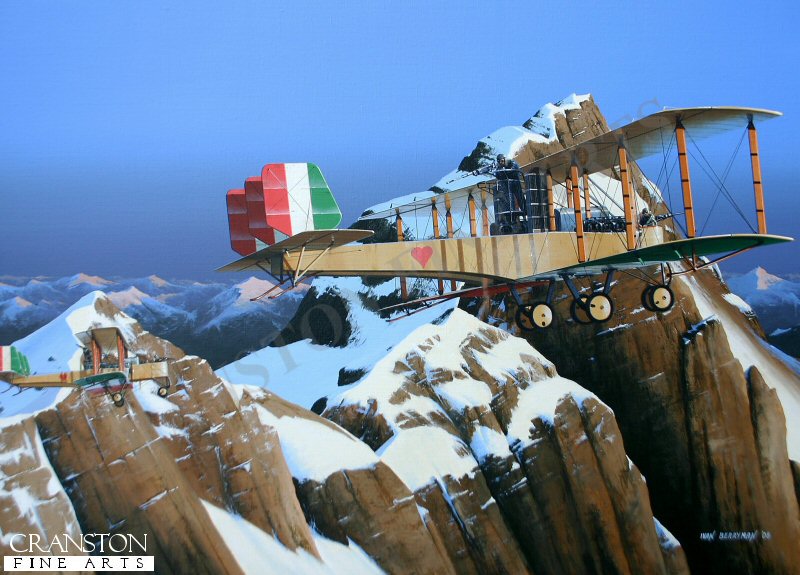
Caproni Ca.3 by Ivan Berryman. (PC) The Italian Caproni series of bombers were the first to carry out long range missions during World War 1, frequently making round trips of over 150 miles in freezing conditions to deliver their meagre 1000lb bomb load on Austro-Hungarian targets. Here, a pair of Ca.3s return home, their gunners keeping a watchful eye for enemy fighters. The aerial gunners were particularly exposed to the sub-zero slipstream and often found it almost impossible to operate their guns because they were so cold, the rear gunners position being especially unpleasant due to his proximity to the mid engine and propeller that was just inches from his feet. |
Handley Page 0/400s by Ivan Berryman. (PC) For so large a machine, production of the Handley Page 0/400 was considerable with over 400 examples being delivered by the time of the Armistice in 1918. Its first missions were carried out during April of that year, operating both during daylight and by night. Here, three machines are being readied for a sortie. As final checks are completed on the nearest aircraft, some last minute engine maintenance is being carried out on a similar machine in the middle distance. The furthest example is being towed, with its vast wings folded, to the dispersal. |
Leutnant d R Richard Wenzl by Ivan Berryman. (PC) With his personal emblem of black and white fuselage band adorning his Fokker E.V, 153/18, Richard Wenzl briefly commanded Jasta 6, based at Bernes in August 1918, and claimed a modest 6 victories during his career with JG 1. The Fokker E.V was both fast and manoeuvrable, but a series of engine and structural failures meant that these exciting new machines saw only brief service before being re-worked to emerge as the D.VIII, sadly too late to make any impression on the war. Wenzl is shown here in combat with Sopwith Camels of 203 Sqn, assisted by Fokker D.VIIs, which served alongside the E.Vs of Jasta 6. The D.VII shown is that of Ltn d R Erich Just of Jasta 11, also based at Bernes. |
Edward Rickenbacker by Ivan Berryman. (PC) Captain Edward Rickenbacker of the 94th Sqn, United States Air Force, is shown in his Spad S.XIII, pursuing a Fokker D.VII. Eddie scored his first victory on 29th April 1918, but by the November Armistice he had increased his tally to 26 confirmed kills. |
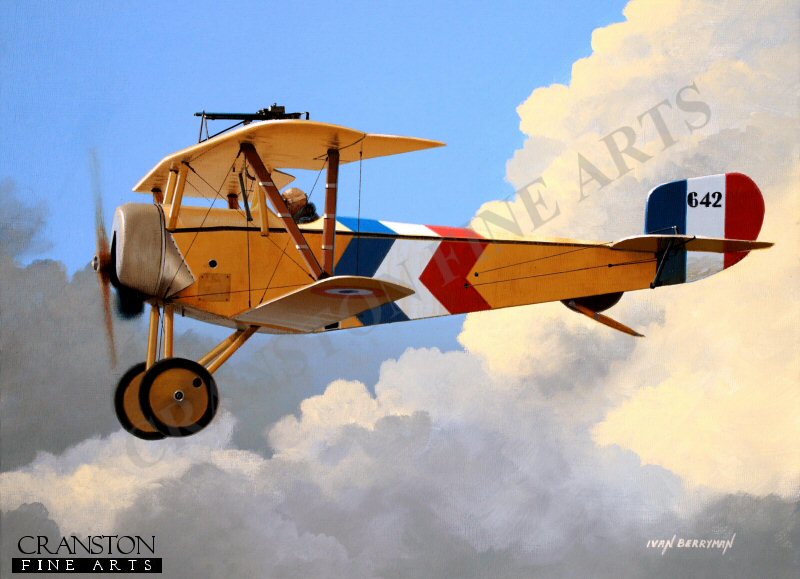
Tribute to Pierre Dufaur de Gavardie by Ivan Berryman. (PC) French Ace Pierre Dufaur de Gavardie claimed a total of six victories - four aircraft and two observation balloons between March and November 1916. He was badly wounded in early 1917 and despite recovering, would not fly in the war again. Pictured here in his Nieuport 11, he flew with Escadrille 12 and was awarded the Croix de Guerre, Legion d'honneur and Medal Militaire. He died aged 76 in 1966. |
Major William Barker VC, DSO - Nearly an Ace in a Day by Ivan Berryman. (PC) Flying Sopwith Snipe E8102 on 27th October 1918, Major William Barker encountered a flight of fifteen Fokker D.VIIs and decided to take them on single handed. Having downed one enemy aircraft, Barker was wounded in his left thigh and momentarily fainted. Coming to, he found another D.VII ahead of him and immediately resumed the battle. Another bullet now tore into his right leg and another shattered his left elbow. Despite his terrible injuries, Barker shot down three D.VIIs and drove the others off before crash landing his bullet-riddled Snipe in friendly territory. He survived the crash and was awarded the VC for his gallantry on this epic flight. |
Lieutenant Croye Rothes Pithey and Lieutenant Hervey Rhodes, RE.8 by Ivan Berryman. (PC) The Royal Aircraft Factory RE.8 (Reconnaissance Experimental 8), or Harry Tate as its crews affectionately called it, was used throughout the Great War to good effect, but was something of an anachronism when pitted against the more modern machines of the Jastas. However, Lieutenants Rothes Pithey and Rhodes scored a credible 10 victories together, sending down three Pfalz D.IIIs on a single mission on 7th June 1918 flying F6097. |
A Thrilling Charge by Cyrus Cuneo. (PC) No text for this item |
Bayonet Charge of the London Scottish at Messines, Halloween 1914 by Allan Stewart (PC) At the Battle of Messines during October 1914, the London Scottish a part of the British Expeditionary Force, participated in the defence of the Ypres Salient. The London Scottish were positioned in key defensive locations to hold the line against the advancing enemy. Despite suffering heavy casualties, they displayed ferocious resistance at one point conducting a bayonet charge counter-attack against an overwhelming German advance. |
Lieutenant Reginald Warneford by Ivan Berryman. (PC) Having successfully weaved and dodged the hail of bullets from the defensive guns of the German Zeppelin, Lieutenant Warneford climbed above the giant airship and prepared for a run along the full length of the LZ.37 in the hope that his 20lb bombs would turn it into an inferno and bring it down. Warneford had time to release all six of his bombs, the last of which set off a chain of eruptions that resulted in the Zeppelin breaking its back before plunging to earth in a fireball. So violent was the initial explosion that Warnefords tiny Morane Saulnier Type L was flipped over and thrust 200ft into the air above the disintegrating leviathan. Warneford survived this historic interception, whilst the LZ.37 plunged to the ground near Ghent and was completely destroyed. This was the first time that a Zeppelin had been brought down by an aircraft for which gallant action, Warneford was awarded the Victoria Cross. Special mention should be made of the roundels on the Type L, where the original French examples were not overpainted to British colours on the wings, unlike those on the fuselage sides. |
Sous-Lieutenant Charles Nungesser by Ivan Berryman. (PC) Surely one of the most irrepressible aces of World War 1, Frenchman Charles Nungessers victory total of 43 confirmed kills and a further 11 probables was achieved despite surviving a number of crashes and accidents from which he always bounced back in defiance of his quite severe injuries. His fame and prowess brought him a personal challenge from his German adversaries to take part in a one-on-one combat. Accepting the challenge, the lone Nungesser encountered not one, but six, enemy aircraft and promptly sent two of them down in flames. In this picture, his Emblems of Mortality personal motif is clearly seen on the side of his Nieuport 23 as he sees off an Albatross toward the end of the war. Nungesser survived the Great War, only to be lost over the Atlantic when attempting a flight to New York in 1927. |
Battle of the Somme, the Attack of the Ulster Division by J P Beadle. (PC) A classic art print of the Ulster Division advancing into the German trenches during the Battle of the Somme. The officer shown leading the unit is Lt Francis Bodenham Thornley. During the Battle of the Somme he was wounded while serving with B company Royal Irish Rifles and while recuperating he was given the job to advise J P Beadle on the painting. In the painting the troops are shown with the SMLE Rifle which is fitted with the No. 1 Mk 1 pattern Sword bayonet. Also shown in the painting is a soldier carrying a Battalion marker, which is used to show the Battalions progress. The troops shown are of the 5th battalion Royal Irish Rifles (North Belfast Volunteers) a supporting unit to the 108th Infantry Brigade. |
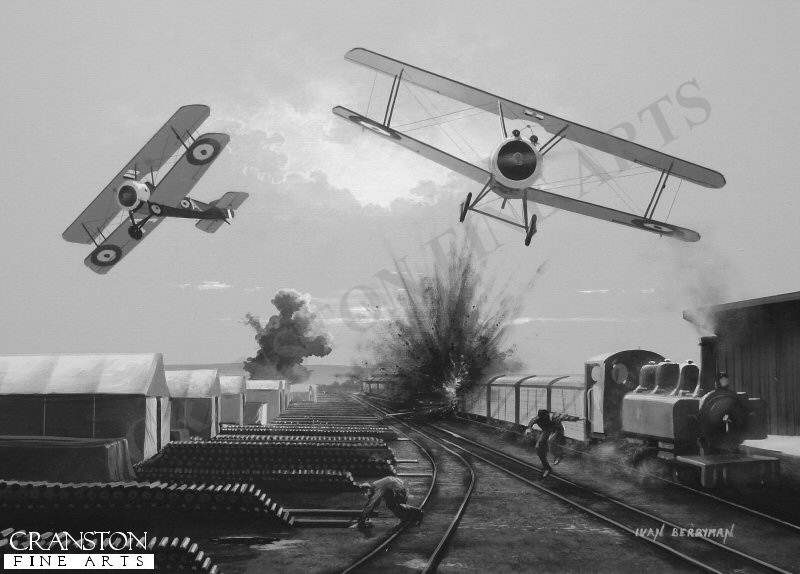
Mayhem at Vieille Chapel by Ivan Berryman. (PC) No text for this item |
The Young Stallion by Ivan Berryman. (PC) Italy's highest-scoring flying ace of WW1 was Francesco Baracca, seen here on the morning of 3rd June 1917, claiming his 13th victim, a Hansa-Brandenburg C.1 two-seater of the Austro-Hungarian Army Air Force above the Isonzo River, near to Plava. His yellow Spad S.VII was easily identifiable by the elegant prancing horse emblem that was painted on the fuselage sides of all his aircraft. Having achieved a total of 34 aerial victories, Baracca was killed in action during the Battle of the Piave, his Spad being shot down by an enemy Phönix C.1 close to the Montello. When his body was recovered from the burned-out remains of his aircraft, he was found to have a bullet hole in his skull and his pistol in his hand. Whether he committed suicide to avoid burning to death or was shot after crashing is unknown. In 1923, Baracca's mother, Countess Paolina, donated the prancing horse emblem to Enzo Ferrari, whose cars have carried this iconic symbol ever since. |
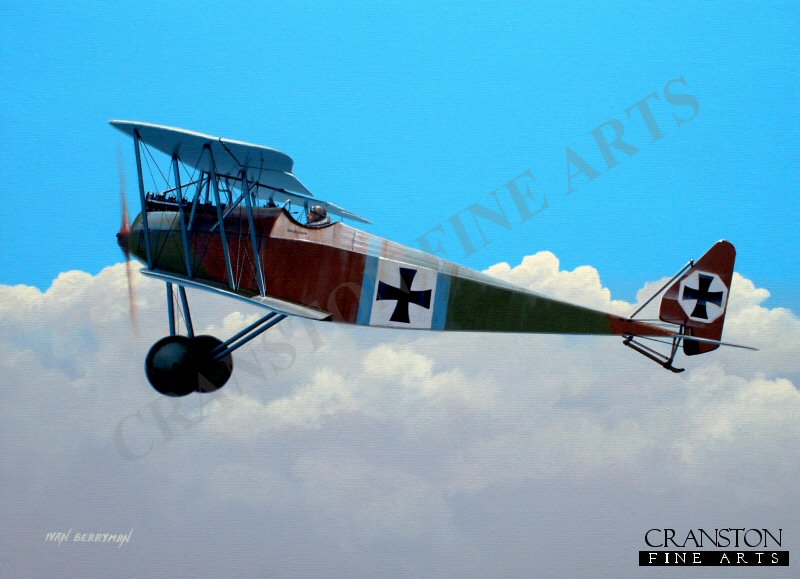
Tribute to Hans-Joachim Buddecke by Ivan Berryman. (PC) Hans-Joachim Buddecke was only the third ace to be awarded the Blue Max (after Max Immelmann and Oswald Boelcke), and was credited with a total of thirteen confirmed victories and many more unconfirmed. Seen here flying with Jasta 4 in a Halberstadt D.V in 1916 on the Western Front, he had previously flown Fokker Eindeckers here, and had served in Bulgaria and Gallipoli. He was shot down and killed in March 1918. |
Advance into Hell by Jason Askew. (PC) No text for this item |
SMS Seydlitz 1916 by Randall Wilson. (PC) Down by the bows, the battered Seydlitz returns to the Jade after being heavily involved in the gun line action at Jutland. |
Grid Caldwell by Graeme Lothian. (PC) Grid Caldwell, the top New Zealand Ace with 25 victories in his SE5A of 74 Squadron, is shown taking off from his home airfield during the Great War. Keith Logan (Grid Caldwell) was born 16th October 1895. At the outbreak of World War One, Caldwell joined the territorial army. He attempted to enlist with the New Zealand expeditionary force destined for Gallipoli but was refused. In October 1915 he paid the sum of £100 to join the first class of the New Zealand Flying School. In January 1916 Grid Caldwell arrived in England and was commissioned into the Royal Flying Corps in April that year. In July 1916 he was posted to No.8 Squadron, flying BE2Cs and Ds on observation duty. It was on 18th September 1916 his first aerial victory was scored, shooting down a Roland CII. He transferred to 60 Squadron in November and flew Nieuport 17 fighters and was promoted to Captain in February 1917. During this period he scored further victories, shooting down Albatros Scouts, and on 17th September was awarded the Military Cross. In October 1917 he was posted back to England as an instructor. In March 1918, promoted to Major, he was given command of 74 Squadron RAF flying SE5As. The squadron under his command was credited with 140 aircraft destroyed and 85 out of control. This tally was scored in the last eight months of the war with the loss of only 15 pilots killed or taken prisoner. During his wartime flying, he had fought dogfights with German aces Werner Voss and Herman Becker, and he once survived a mid-air collision, bringing his badly damaged aircraft to ground level, jumping out before it crashed. He was credited with 11 aircraft destroyed, 3 shared destroyed or captured and 10 out of control, and 1 further shared out of control. During World War Two he was station commander at Woodbourne and later Wigram and posted to India in 1944. After the war he was made commander of the British Empire. He retired from the RNZAF in 1956, and sadly died of cancer in Auckland on 28th November 1980. |
Josef Kiss by Ivan Berryman. (PC) Flying from Pergine airfield in Northern Italy some time in March 1918, Offz Stv Josef Kiss is depicted on patrol over the Piave in Albatros DIII (Oef) 153.186, his aircraft carrying the personalised 'medal' decoration overpainted with a white 'K'. Below him is the similar aircraft of Oblt Josef von Maier, also of Flik 55/J. Kiss was to attain a victory score of 19 aircraft destroyed before being killed in combat on 24th May 1918. |
Sous-Lieutenant Willy Coppens - Roasting A Sausage by Ivan Berryman. (PC) During an amazing spree of balloon-busting during 1918, Willy Coppens gained notoriety over the Western Front for his sheer daring and marksmanship, sending no fewer than 35 observation balloons plummeting to the ground, as well as two aircraft. Here, Coppens despatches a Drachen balloon flying his modified Hanriot HD.1 No23 which he had painted blue because he so disliked the ugly, bad camouflage in which it was delivered. Despite losing a leg whilst downing his final two balloons, Coppens survived the war and lived a full life until his death in December 1986. |
|
Contact Details |
|
Sign Up To Our Newsletter!
This website is owned by Cranston Fine Arts. Torwood House, Torwoodhill Road, Rhu, Helensburgh, Scotland, G848LE Contact: Tel: (+44) (0) 1436 820269. Email: cranstonorders -at- outlook.com
|
 |