|
|
|
|
|
|
|
|
|
First World War Art  Postcards Postcards |
| Navigation | |
| Page 2 of 12 | Previous .. Page 2 .. Next |
|
|
|
|
|
|
|
|
|
|
|
|
|
|
|
|
|
|
|
|
|
| Navigation | |
| Page 2 of 12 | Previous .. Page 2 .. Next |
| Text for the above items : |
F Korty-Lalitz, Aviatik D.1 by Ivan Berryman. (PC) Set against a spectacular Alpine backdrop, a pair of Aviatik D.1s of Flik 17/D are shown on patrol in March 1918, the nearest aircraft being that of Zugsfuhrer F Korty-Lalitz. When first entering service, the D.1 was praised by its pilots for possessing an excellent climb rate and outstanding performance, but its woeful lack of synchronised armament and poor forward visibility compromised the D.1s ability to meet its enemies on equal terms, these examples being armed only with a single over-wing Schwarzlose M7/16 or M16 machine gun. |
The Grenadier Guards Saluting The Colour by Douglas Macpherson (PC) Prior to going on guard for the day an assembly of grenadier guards salute the colour. |
The 79th Victory by Ivan Berryman. (PC) For Manfred von Richthofen, the air battle in the skies west of Amiens on 20th April 1918 was to yield a final two victories to add to the seventy eight with which he was already credited. But these were to be his last, the Red Baron finally succumbing the following day. Just moments before Second Lieutenant David Lewis' 3 Sqn Sopwith Camel fell to the German's guns (the young pilot surviving to tell his story of being the Red Baron's final victim), Major Richard Raymond-Barker was not so lucky, his aircraft burning furiously until it hit the ground in a fireball near the Forest of Hamel. |
SMS Emden by Ivan Berryman. (PC) SMS Emden served in both Chinese and Pacific waters and was at the German colony of Tsingtao when war broke out. She was ordered to start raiding and disrupting commercial vessels in the Indian Ocean until she was cornered by HMAS Sydney. She was beached after the battle on 9th November 1914 and the wreck was partly scrapped by the Japanese in 1950. Some of her crew managed to reach Germany again after capturing a ship and traveling to Mecca. |
Alone in a Winter Sky - Fokker Triplane DR1 by David Pentland. (PC) Rittmeister Karl Bolle Commander Jasta 2 early 1918. |
Gotha G. V. by Ivan Berryman. (PC) Bathed in the low winter sun over southern England, Gotha G.V.s are attacked by defending Sopwith Camels as the German bombers penetrate the south-eastern counties en route to London. This was, effectively, the first Battle of Britain, staged during the winter of 1917/18, during which the intruders were frequently repelled, their bomb loads falling harmlessly on English soil. |
Tribute to Ferdinand West VC by Ivan Berryman. (PC) Known as Freddie, West was the first pilot of the newly formed Royal Air Force to be awarded the Victoria Cross. He is shown here during a bombing mission to Merricourt on 19th June 1918. Jumped by enemy fighters, he was forced to evade his assailants by weaving through German barrage balloons. Successfully shaking off the Fokkers in Armstrong-Whitworth FK.8 C8594, he continued to his intended target. Less than two months later, and in a similar aircraft, he undertook the mission which earned him his VC, but cost him an amputated leg. He remained in the RAF until the end of World War Two and lived until 1988, aged 92. |
Sopwith 1 ½ Strutter by Ivan Berryman. (PC) The potential value of aircraft at sea had been proven as early as the Battle of Jutland in 1916 and many experiments were undertaken to provide all significant warships with their own aircraft for spotting and reconnaissance purposes. One solution widely adopted was the fitting of flying-off platforms to the main guns, as demonstrated here, as a Sopwith 1½ strutter is launched from HMS Warspite in 1919. |
French Artillery Crossing the River Aisne, September 1914 by John Charlton. (PC) Another incident in the retreat of the Germans from the Marne. They were pursued by the French and British to the River Aisne. Although the bridges had been destroyed, pontoon bridges were hastily constructed, and the French artillery is here seen crossing in face of the enemy's fire from the other flank. |
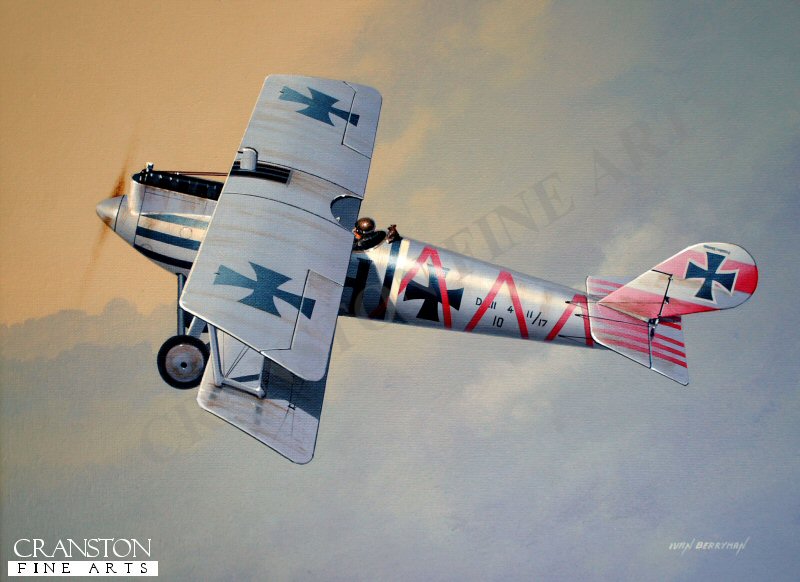
Tribute to Friedrich 'Fritz' Höhn by Ivan Berryman. (PC) Fritz Höhn was a German Ace of World War One despite only scoring his first victory in the final month of 1917. He is depicted here in his Pfalz D.III of Jasta 21s in the spring of 1918. The red markings on this aircraft were intended to confuse the aim of enemies, but the teddy bear he carried behind the cockpit was just for luck. He later flew a Fokker D.VII and in total claimed 11 enemy aircraft and 10 observation balloons, scoring his last victory on the 3rd of October 1918, the same day on which he himself was shot down and fatally wounded by a French aircraft. |
Battle of the Falkland Islands by Randall Wilson. (PC) Admiral von Spees Flagship SMS Scharnhorst leads SMS Gneisenau in the opening stages of engaging the Royal Naval ships east of the Falklands, 8th December 1914. |
Oberleutnant Godwin Brumowski by Ivan Berryman. (PC) Albatros DIII of Godwin Brumowski about to shoot down a Caquot balloon. |
Albatros W.4 by Ivan Berryman. (PC) In response to a requirement for a seaplane fighter scout, Albatros developed the elegant W.4, a direct descendent of their successful D.1, incorporating many common parts with its land-based relative. About 120 of the type were constructed, many employed in the defence of important naval bases scattered along the coast of the North Sea. A small number of W.4s however fell into the hands of the Soviet Red Army in 1918 and were pressed into service on the Black Sea, based at Sevastopol, as depicted here. |
Sikorski Ilya Muromets by Ivan Berryman. (PC) Designed in 1913 and constructed by the Russo-Baltic Carriage Factory in Riga, the Ilya Muromets was designed by the great Igor Sikorski, based on his earlier creation, the Bolshoi Baltiski. Conceived originally as a luxury passenger aircraft, it was to become the worlds first four-engined strategic bomber at the outbreak of World War 1 and featured a fully enclosed cabin for the pilots and internal bomb racks that could carry up to 800kg of bombs. 73 examples of this extremely successful aircraft were built and only one was lost due to enemy action during the 400 sorties flown, during which their bombing accuracy was claimed to have achieved a commendable 90 percent success rate. |
Oblt Friedrich Navratil by Ivan Berryman. (PC) Born of Croatian parents in Sarajevo in 1893, Friedrich Navratil served under the Austro Hungarian flag throughout his considerable military career, becoming an outstanding pilot with Flik 3J on the Italian Front. He is depicted here chasing down a Hanriot of 72A Squadriglia da Caccia over Val del Concei in August 1918 to claim his third of ten victories. Navratil's distictive Albatross D.III (Oef) 253.06 was easily identifiable by his personalised 'Pierced Heart' emblem and is unusual in sporting the then new Balkenkeuz cross, untypical of Austro-Hungarian aircraft in WW1. |
HMS Benbow at the Battle of Jutland by Anthony Saunders. (PC) HMS Benbow was completed in 1914, built by Beardmore (launched 12th November 1913). On the 10th of December she joined the Grand Fleet serving with the 4th Battle squadron. She was the flagship to Admiral Douglas Gamble until he was replaced in February 1915 by Sir Doveton Sturdee. During the Battle of Jutland. she suffered no damage. After the war she served from 1919 in the Mediterranean providing Gun fire support to the white Russians in the Black Sea until 1920. She remained in the Mediterranean until 1926 joining the Atlantic fleet for the next three years until 1929 when she was paid off and scrapped in March 1931. |
Leutnant Hans von Keudell by Ivan Berryman. (PC) An early star of Jasta 1, von Keudell is depicted here in his Halberstadt D.III, (instantly identifiable by his initial K on the fuselage side) as he drifts into position to exploit the blindspot of a Vickers Gunbus, late in the day in 1916. Von Keudells closing tally was 11 confirmed victories, but a possible 12. |
2nd Battle Squadron at the Battle of Jutland by Randall Wilson. (PC) HMS Orion leading HMS Conqueror, HMS Monarch, HMS Thunderer, the 2nd Battle Squadron. |
Christmas Kiss - Albatros DV by David Pentland. (PC) Albatros DV piloted by Austro-Hungarian Ace Lt. Josef Kiss, Austrian Alps in December 1917. |
Leutnant Josef Jacobs by Ivan Berryman. (PC) Germanys greatest exponent of the Fokker Dr1 Triplane, Leutnant Josef Jacobs is depicted chatting with colleagues of Jasta 7 before a sortie in the spring of 1918. His black Triplane became well known to allied pilots, not least because of his formidable kill rate. By the end of the war, still aged just 24, Jacobs had claimed 48 enemy aircraft destroyed. The unusual practice of applying the black cross to the upper sides of the lower wings was to counter friendly fire from other German aircraft who frequently mistook the Dr1 for a Sopwith Triplane. |
Lanoe G Hawker by Ivan Berryman. (PC) Major Lanoe G Hawkers Bristol Scout C 1611, the No 6 Sqn aircraft in which he shot down two enemy planes on 25th July, 1915, and sufficiently damaged a third enemy aircraft to force it to the ground. He is shown here in combat with an Albatross C.III - soon to fall as one of his victims that day. Lanoe G Hawker earned the first aerial Victoria Cross (VC) of the war for this action, but was killed in November 1916, after a lengthy battle with the infamous Red Baron, Manfred von Richthofen, becoming his 11th victim. |
|
Contact Details |
|
Sign Up To Our Newsletter!
This website is owned by Cranston Fine Arts. Torwood House, Torwoodhill Road, Rhu, Helensburgh, Scotland, G848LE Contact: Tel: (+44) (0) 1436 820269. Email: cranstonorders -at- outlook.com
|
 |